

Introduction
Expanding into international markets is one of the most effective ways for a business to increase revenue, diversify its customer base, and build long-term growth. Modern logistics, digital marketplaces, and global communication have made exporting more accessible than ever before. Today, companies of every size can sell products beyond their domestic borders.
Despite these opportunities, exporting is rarely simple. Every shipment must comply with customs regulations, documentation requirements, product standards, transportation rules, and country-specific trade laws. Missing a single document or misunderstanding an export regulation can delay shipments, increase costs, or damage valuable customer relationships.
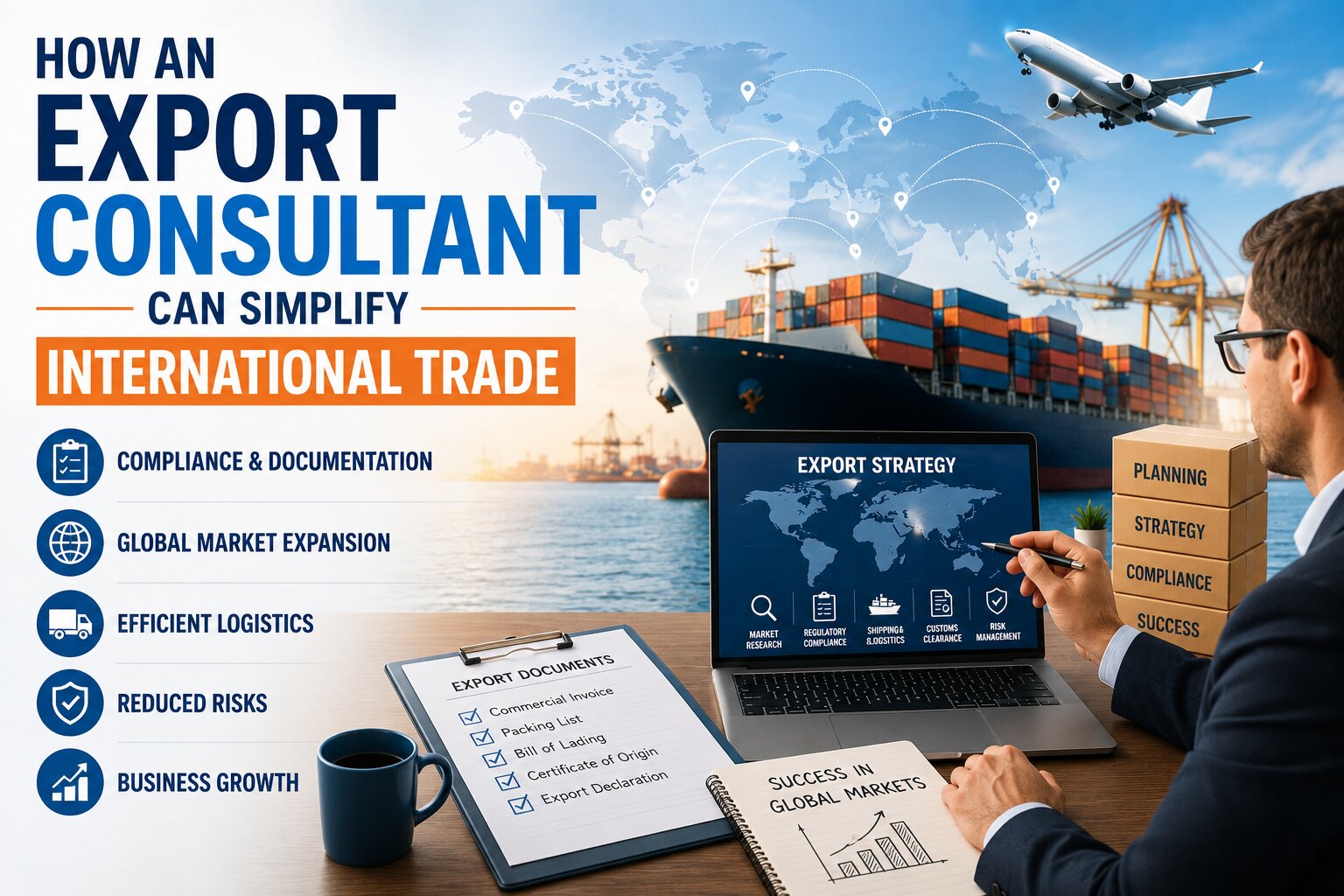
This is why many businesses choose to work with an export consultant. Rather than navigating complex international trade requirements alone, companies gain access to practical expertise that helps simplify every stage of the export process.
Whether a business is shipping products internationally for the first time or expanding into several global markets, an experienced export consultant provides guidance that improves compliance, reduces operational risks, and creates more efficient export procedures.
In this guide, you’ll learn what an export consultant does, why businesses rely on export consultants, and how professional guidance can make international trade more predictable and profitable.
What Is an Export Consultant?
An export consultant is a trade professional who helps businesses manage the legal, operational, and strategic aspects of exporting goods to international markets.
Their responsibilities extend well beyond preparing paperwork. They help businesses understand export regulations, develop compliance procedures, improve shipping operations, and identify opportunities for international growth.
Typical responsibilities include:
- Export compliance guidance
- Documentation review
- Export licensing support
- Customs preparation
- Product classification
- International logistics planning
- Market entry advice
- Supply chain optimization
- Risk assessment
- Trade strategy development
Rather than reacting to problems after they occur, export consultants help businesses establish systems that prevent costly mistakes before shipments leave the warehouse.
Why International Trade Is Becoming More Complex
Global commerce has become increasingly interconnected.
However, it has also become more regulated.
Businesses exporting products internationally now encounter challenges such as:
- Frequent regulatory updates
- Country-specific import requirements
- Product certification rules
- Customs inspections
- Export control regulations
- Sanctions and restricted-party screening
- Supply chain disruptions
- Rising transportation costs
Keeping pace with these changes requires both experience and continuous monitoring.
For growing businesses with limited internal trade expertise, managing these responsibilities alone can quickly become overwhelming.
Why Businesses Hire an Export Consultant
Many business owners believe they only need professional assistance after experiencing customs delays or compliance problems.
In reality, the greatest value comes from preventing issues before they occur.
An export consultant helps businesses:
- Understand international regulations
- Develop efficient export procedures
- Reduce compliance risks
- Improve documentation accuracy
- Support global expansion
- Increase operational efficiency
This proactive approach saves both time and money while protecting customer relationships.
Simplifying Export Compliance
Compliance forms the foundation of successful international trade.
Every export transaction must satisfy applicable regulations in both the exporting country and the destination market.
Failure to comply may result in:
- Shipment delays
- Customs penalties
- Product seizures
- Export restrictions
- Financial losses
- Reputational damage
An export consultant helps businesses understand these obligations before shipments move internationally.
Rather than responding to regulatory issues after they arise, businesses establish compliant processes from the beginning.
Improving Documentation Accuracy
Documentation remains one of the most common causes of export delays.
International shipments typically require several documents, including:
- Commercial invoices
- Packing lists
- Certificates of origin
- Export declarations
- Bills of lading
- Insurance documents
Every document must be accurate and consistent.
Even small discrepancies can result in customs inspections or delayed clearance.
An export consultant reviews documentation before shipment, helping businesses avoid these preventable mistakes.
Supporting International Market Expansion
Entering a foreign market involves much more than finding overseas buyers.
Businesses must evaluate:
- Local demand
- Product regulations
- Competition
- Pricing expectations
- Distribution channels
- Customer preferences
An export consultant helps companies research potential markets before making significant investments.
Instead of relying on assumptions, businesses make decisions supported by market research and international trade expertise.
Helping Businesses Reduce Export Risks
Every international shipment carries some level of uncertainty.
Common export risks include:
Regulatory Risks
Governments regularly revise export regulations, sanctions, and licensing requirements.
Businesses that fail to monitor these changes may unintentionally violate trade laws.
Logistics Risks
International transportation involves multiple parties, including freight carriers, customs agencies, warehouses, and distributors.
Unexpected disruptions can delay deliveries and increase costs.
Financial Risks
Export transactions often involve currency fluctuations, payment terms, and unfamiliar buyers.
Careful planning reduces exposure to financial uncertainty.
Documentation Risks
Incorrect paperwork remains one of the leading causes of customs delays.
Professional guidance significantly reduces this risk.
Improving Supply Chain Efficiency
Successful exporting depends on reliable logistics.
An export consultant evaluates existing supply chain processes to identify opportunities for improvement.
Recommendations may include:
- Better shipping routes
- Improved inventory planning
- More efficient freight coordination
- Alternative transportation options
- Stronger supplier relationships
Small operational improvements often produce substantial long-term savings.
Supporting Small Businesses
Many entrepreneurs assume export consultants only work with multinational corporations.
In reality, small businesses often benefit the most.
Growing companies typically have limited internal compliance resources.
Working with an export consultant allows business owners to access specialized expertise without building an entire international trade department.
This helps smaller businesses compete more confidently in global markets.
Building Long-Term Export Strategies
Successful exporters rarely focus only on individual shipments.
Instead, they develop systems that support consistent international growth.
Export consultants help businesses establish repeatable procedures for:
- Compliance management
- Documentation preparation
- Supplier coordination
- Customer onboarding
- Logistics planning
- Risk management
These systems improve operational consistency as export volumes increase.
Choosing the Right Export Consultant
Not every consultant offers the same level of experience or expertise.
When evaluating potential professionals, businesses should consider:
Industry Experience
Industry-specific knowledge often leads to more practical recommendations.
Regulatory Expertise
A strong understanding of export regulations, customs requirements, and international documentation is essential.
Communication Skills
Effective consultants explain complex trade requirements clearly, allowing business owners to make informed decisions.
Problem-Solving Ability
Unexpected challenges occur in international trade.
Experienced export consultants provide practical solutions that minimize disruptions while maintaining compliance.
When Should You Hire an Export Consultant?
Many businesses wait until they experience customs delays or compliance issues before seeking professional guidance. By that point, the problem has already affected delivery schedules, customer relationships, or operating costs.
An export consultant provides the greatest value when involved early in the planning process. Preparing before shipments begin is almost always more effective than correcting mistakes afterward.
Consider working with an export consultant if your business is:
- Exporting products for the first time
- Entering a new international market
- Expanding into multiple countries
- Launching a new product line overseas
- Experiencing recurring customs delays
- Managing high-value or regulated products
- Building an internal export compliance program
- Reviewing supply chain performance
Early planning helps businesses establish reliable procedures that support long-term international growth.
Common Export Mistakes Businesses Can Avoid
International trade involves many moving parts. Even experienced companies occasionally encounter challenges, but many common mistakes are preventable with the right preparation.
Some of the most frequent export issues include:
Incomplete Documentation
Missing or inaccurate paperwork remains one of the leading causes of shipment delays.
Businesses should carefully review every document before products leave the warehouse.
Incorrect Product Classification
Products must be assigned the correct classification codes for customs purposes.
Incorrect classifications may result in additional duties, customs disputes, or shipment delays.
Ignoring Country-Specific Requirements
Every destination country has unique regulations.
Some require product registrations, language-specific labels, certifications, or additional inspections before imported goods can enter the market.
Understanding these requirements before shipping prevents unnecessary complications.
Weak Recordkeeping
Maintaining organized records is an essential part of export compliance.
Accurate documentation helps businesses respond quickly to customs inquiries, internal audits, and regulatory reviews.
Limited Risk Planning
Unexpected events such as transportation delays, supplier disruptions, weather conditions, or policy changes can interrupt international shipments.
Developing contingency plans allows businesses to respond more effectively when challenges arise.
How Export Consultants Support Long-Term Business Growth
Exporting should not be viewed as a series of isolated shipments. It is an ongoing business strategy that requires consistency, planning, and continuous improvement.
Professional export consultants help companies create systems that support sustainable growth rather than temporary success.
Better Decision-Making
Reliable information leads to better business decisions.
Consultants provide practical insights into regulations, logistics, documentation, and international market conditions, helping business owners make informed choices with greater confidence.
Increased Customer Confidence
International buyers value suppliers who consistently deliver products on time while meeting all regulatory requirements.
Strong export procedures improve reliability, strengthen customer relationships, and encourage repeat business.
Improved Operational Efficiency
As export volumes increase, standardized processes become increasingly important.
Export consultants help businesses document procedures, improve internal workflows, and reduce unnecessary delays.
Efficient operations often lead to lower costs and higher customer satisfaction.
Easier Global Expansion
Businesses planning to enter additional countries can build on established export procedures instead of creating new systems for every market.
This makes international expansion more manageable and supports long-term scalability.
The Future of Export Consulting
Global trade continues to evolve as technology, regulations, and customer expectations change.
Several trends are shaping the future of international business.
Digital Trade Processes
Electronic documentation, digital customs systems, and automated shipment tracking continue to improve efficiency across global supply chains.
Businesses adopting digital processes often experience faster communication and better operational visibility.
Greater Focus on Compliance
Governments around the world continue introducing new trade regulations and reporting requirements.
As compliance becomes increasingly complex, businesses are placing greater value on expert guidance.
Supply Chain Resilience
Recent global events have highlighted the importance of flexible supply chains.
Many businesses are diversifying suppliers, transportation routes, and sourcing strategies to reduce future disruptions.
Export consultants play an important role in helping companies adapt to these changing conditions.
Data-Driven Decision Making
Businesses increasingly use data to evaluate shipping performance, identify operational improvements, and make strategic export decisions.
Combining data analysis with professional expertise creates stronger international trade strategies.
Final Thoughts
International trade offers tremendous opportunities for businesses seeking long-term growth. Access to new customers, expanded revenue streams, and diversified markets can strengthen an organization for years to come.
However, successful exporting requires far more than arranging transportation. Companies must understand regulations, prepare accurate documentation, manage logistics, reduce risks, and adapt to changing international requirements.
An experienced export consultant helps simplify these responsibilities by providing practical guidance throughout the export process. From compliance planning and customs preparation to market expansion and supply chain improvement, their expertise allows businesses to operate more confidently in global markets.
Professional export consultants also help organizations build repeatable systems that improve efficiency over time. Instead of solving one shipment at a time, businesses create structured processes that support sustainable international growth.
Whether a company is preparing its first export shipment or expanding into several international markets, investing in knowledgeable guidance helps reduce uncertainty while creating stronger foundations for future success.
In today’s increasingly competitive global economy, businesses that combine quality products with well-managed export operations are better positioned to build lasting international relationships and achieve consistent long-term growth.
Frequently Asked Questions
What does an export consultant do?
An export consultant helps businesses manage international trade by providing guidance on export regulations, customs documentation, compliance, logistics, market entry strategies, and risk management.
How can export consultants help small businesses?
Export consultants help small businesses understand international trade requirements, avoid costly compliance mistakes, improve shipping processes, and expand into global markets with greater confidence.
When should a business hire an export consultant?
Businesses should consider hiring an export consultant before exporting for the first time, entering new international markets, launching regulated products, or whenever recurring customs or compliance issues arise.
What industries benefit from export consultants?
Manufacturers, wholesalers, distributors, agricultural businesses, medical device companies, technology firms, automotive suppliers, and consumer goods companies all benefit from professional export consulting.
Can an export consultant reduce international trade risks?
Yes. An export consultant helps businesses minimize risks by improving compliance, reviewing documentation, monitoring regulations, strengthening supply chain processes, and identifying potential issues before shipments move internationally.