

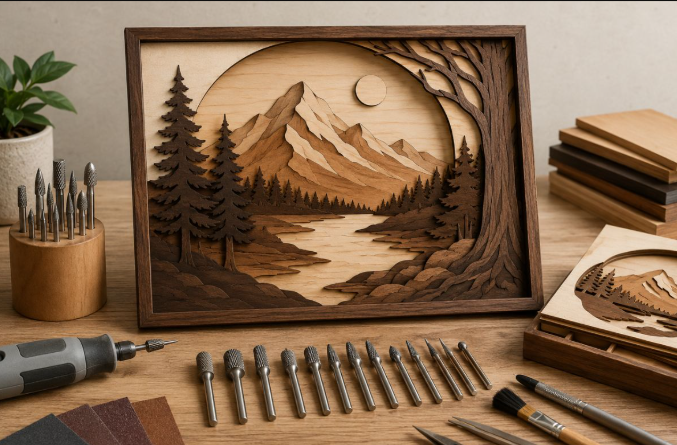
Woodworking has evolved from traditional carpentry into a highly creative art form that blends craftsmanship with design innovation. Among the many modern woodworking styles, layered wood art has gained significant popularity for its ability to create depth, dimension, and visual storytelling using simple wooden materials. This technique transforms flat wooden sheets into intricate 3D-style compositions that stand out as both decorative and artistic expressions.
Unlike conventional wood carving that focuses on shaping a single block of wood, layered wood designs rely on stacking multiple cut layers to build depth and perspective. This makes it accessible to both hobbyists and professional artisans who want to explore creative woodworking without requiring highly advanced carving skills.
What is Layered Wood Art?
Layered wood art is a technique where multiple thin sheets of wood are cut into specific shapes and stacked together to create a three-dimensional visual effect. Each layer contributes to the overall image, adding depth and complexity.
These layers are usually cut using precision tools and then assembled in a way that creates shadows, highlights, and spatial contrast. The final result often resembles a sculpted scene, even though it is constructed from flat materials.
The Creative Process Behind Layered Wood Designs
Creating wood artwork begins with a design concept. Artists typically start by sketching or digitally designing the image they want to create. This design is then divided into multiple layers, each representing a different depth level.
Once the design is finalized, each layer is carefully cut from wood sheets using precision tools. Accuracy is essential because even small deviations can affect how the layers align during assembly.
After cutting, the layers are sanded, painted, or stained, depending on the desired aesthetic. Finally, they are stacked and glued together to create the finished piece.
The process behind layered wood art requires patience and attention to detail, but it offers endless creative possibilities.
Tools Used in Layered Wood Crafting
Precision tools are essential in this art form. Scroll saws are commonly used for cutting intricate shapes, as they allow for detailed and controlled movements. Sanding tools are also important for smoothing edges and preparing surfaces for assembly.
Adhesives and clamps are used during the layering process to ensure that each section is properly aligned and securely fixed.
Design Inspiration and Artistic Possibilities
One of the most exciting aspects of layered wood crafting is its versatility. Artists can create landscapes, animals, architectural scenes, or abstract patterns using the same basic technique.
Shadows and depth play a key role in enhancing the visual impact of the artwork. By carefully adjusting layer spacing and thickness, artists can create realistic depth effects that make the piece appear almost three-dimensional.
This flexibility makes layered wood art suitable for both minimalist and highly detailed artistic styles.
Applications in Home and Commercial Decor
Layered wood designs are widely used in interior decoration due to their natural aesthetic and handcrafted appeal. They are often displayed as wall art in homes, offices, cafes, and galleries.
Because each piece is customizable, it can be tailored to match different interior themes, from rustic and traditional to modern and contemporary.
Skill Development and Learning Curve
While layered wood crafting is accessible to beginners, mastering it requires practice. Understanding how depth, spacing, and shadow interact is essential for creating visually balanced compositions.
Beginners often start with simple designs before progressing to more complex multi-layer projects. Over time, they develop better control over cutting precision and design planning.
Advantages of Layered Wood Techniques
One of the key advantages of this technique is its accessibility. Unlike traditional carving, it does not require heavy sculpting or advanced hand tools.
It also allows for repeatability, meaning designs can be reproduced with consistent results once the template is created.
Additionally, layered wood projects often produce minimal waste compared to subtractive carving methods, making them more material-efficient.
Conclusion
Layered wood crafting represents a perfect blend of creativity, precision, and traditional woodworking skills. For those exploring woodworking techniques, experimenting with power carving tools for wood alongside layered methods can further expand creative possibilities and enhance craftsmanship skills. Its ability to transform flat materials into visually dynamic compositions makes it a standout technique in modern decorative arts.