

Ready-made parts usually do not suit all applications, which explains why so many engineering firms prefer custom CNC machining whenever there is a need for parts that match the specifications. Be it one piece or several thousand pieces, knowing what the whole custom process entails will be very useful to you.
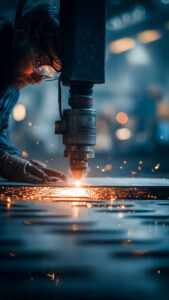
What Makes CNC Machining “Custom”
Custom CNC machining involves manufacturing parts that are designed uniquely by the customer in contrast to using a preexisting set of standard parts from a catalog. In such situations, the manufacture begins with a CAD model or a technical drawing and ends with the manufactured part that meets all the dimensional requirements, tolerance limits, and surface finishes.
In this case, since each of the custom parts originates from a brand new design, the manufacturing company must have a proper understanding of technical drawings, including GD&T dimensions.
The Design-to-Production Workflow
A good project such as this typically involves the following process steps:
- Design review, in which the manufacturer looks for machinability problems, such as impossible internal details or excessive wall thinning
- Selection of materials according to the part’s mechanical and environmental considerations
- CAM programming to specify toolpathing and cut sequence
- Manufacture and inspection of the first article against the drawing
- Complete manufacture after the first article receives final approval
Omitting the step of design review is probably the most frequent reason for delays, because machinability problems found during manufacture usually mean a complete design and manufacturing restart.
Why Custom Precision Machining Requires Closer Collaboration
While buying standardized parts is fairly straightforward, the process of custom precision machining relies heavily on continuous interaction between the engineer and the machinist. The drawings do not always contain all aspects to consider, and an experienced machinist will point out inconsistencies, such as unnecessarily tight tolerances or superfluous details that do not impact functionality.
Those customers who approach this process as a real partnership, rather than a mere order, usually get parts that are both more efficient and cheaper to produce because the manufacturer will be able to provide recommendations that will decrease machining time.
Material and Finish Options Worth Considering
This process of production allows us to have some options for materials that we do not often get from conventional parts:
- Aluminum alloys that are used for light and corrosion-resistant parts
- Stainless and alloy steels that are strong and wear-resistant
- Engineering plastics for insulation against electricity and chemicals
- Bronze and brass as bearing and friction-reducing materials
There are also surface treatment processes like anodizing, bead blasting, and passivation that could be discussed now because their application will not require any redesigning in the future.
Managing Cost Without Compromising Quality
Though custom parts can be expensive to produce compared to their mass-produced counterparts on a per-unit basis, several considerations allow prices to remain affordable:
- Simplification of geometry where high tolerances do not add value to functionality
- Use of machinable materials instead of using higher grade metals automatically
- Purchase of parts in quantities consistent with your usage, as opposed to buying single pieces
Work with a manufacturer who gives you feedback on the manufacturability of the design.
Turning Your Design Into a Reliable Part
Good CNC machining involves alignment of design concept, material selection, and manufacturing capabilities right from the initial discussions, not as an afterthought following a failed first article. Pick one that will treat your custom precision machining needs as a partnership where design suggestions will be offered, and not just a quotation of your drawing. Should you have a design available, ask for a manufacturability check before your actual production order because it’s the best means to prevent costly revisions.
Frequently Asked Questions
1. What information do I need to request a quote?
A properly drafted design or drawing with tolerances, material requirements, quantities, and all the required finishes.
2. How long does a typical project like this take?
For simple items, it takes one or two weeks, while complex assemblies, which go through many stages, can take anywhere from four to six weeks.
3. Is custom CNC machining cost-effective for low volumes?
Yes, it is always less expensive than processes such as injection molding, which require extensive tooling, especially for lower quantities.
4. Can custom precision machining accommodate design changes mid-project?
Modifications can be accommodated before CAM program creation but will incur costs and delays if made during production.
5. What is the biggest risk in projects like this?
Failure to do a manufacturability review results in designs that cannot be machined as shown in the drawings.